How type and spec systems will take your job
Andrii Melnikov
What are our goals?
Whoever thinks that the products of programmers are the programs they write is deeply mistaken. A programmer must produce trustworthy solutions and present them in the form of convincing arguments; the text of the program is merely accompanying material to which those arguments apply.
— Edsger W. Dijkstra (paraphrased)
An argument is a proof
The single source of truth
function sum(a, b) {
  return parseInt(a, 10) + parseInt(b, 10)
}
But truth is fleeting
Everything flows, everything changes
— Heraclitus
The whole is greater than the sum of its parts
— Aristotle
 function sum(a, b) {
-  return parseInt(a, 10) + parseInt(b, 10)
+  return summator(prepareArgs(a, b))
 }
Change and impermanence are built into the very reason code exists.
Observe, don't fight
A flower needs time to grow. So there's no need to strain — better to observe.
— Yongey Mingyur Rinpoche
VCS?
 function sum(a, b) {
-  return parseInt(a, 10) + parseInt(b, 10)
+  return summator(prepareArgs(a, b))
 }
A bit of fun linguistics: change comes from the same root as exchange.

What is good and what is bad?
Behaviour:
- desired (
sum(2, 2)returns 4) - undesired (
sum(2, 2)returns something that isn't a number)
Its proofs:
- proof of the absence of some undesired behaviour — a safety property
- proof of the presence of some desired behaviour — a liveness property

!exists(!safe) ≡ all(liveness) ⇒ all(safe) ≡ all(liveness)The program works correctly
describe('sum', () => {
  it('2 + 2 = 4', () => expect(sum(2, 2)).toBe(4))
})
How many tests are enough?
…or does it?
Program testing can be used to show the presence of bugs, but never to show their absence!
— Edsger W. Dijkstra
A program is a function
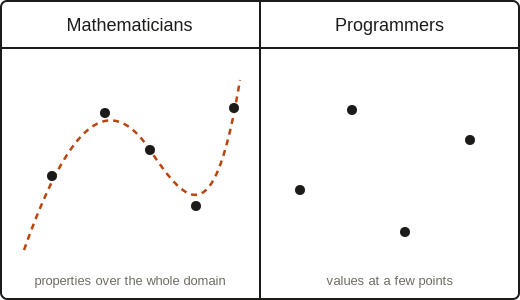
f(x) = yA test checks the function at one point
f(2) = 1The set of points a program is defined on is usually close to infinite.
Mathematicians vs programmers
Mathematicians
- domain and codomain
- properties (parity, monotonicity, etc.)
- values at specific points (inflection points, extrema, and just some random points)
Programmers
- values at specific points
At least don't break anything
- the sum of non-negative numbers is at least each summand:
a + b >= a && a + b >= b - sorting is idempotent:
sort(sort(x)) ≡ sort(x) reverseis its own inverse:reverse(reverse(str)) ≡ str- sorting doesn't change a list's length:
length(sort(x)) ≡ length(x) - the sum of two numbers is a number:
typeof sum(a, b) ≡ 'number'
There are two ways…
Prove the property statically with Coq / Agda / TLA+ / Lean

Just check the property on very many random points
∀ x ∈ random() × 1000
Property-based testing
Steps:
- describe the property as a check, a.k.a. invariant, a.k.a. contract
- generate lots of different arguments for a function (or a set of functions)
- check that the property holds for all of them
Libraries:
- testcheck.js (a port of Clojure's test.check)
- jsverify
Back to real life
function convertFrom(structFromBackend) {
  ...
  return structForFrontend;
}
function convertTo(structForFrontend) {
...
return structFromBackend;
}function isRevertable(structFromBackend) {
var structForFrontend = convertFrom(structFromBackend);
var structForBackend = convertTo(structForFrontend);
expect(structFromBackend).toEqual(structForBackend);
}How do you make a family?
jsc.string // generates strings
jsc.record({ ... }) // generates records
jsc.elements([ ... ]) // picks one of the elements
jsc.oneof([ ... ]) // uses one of the generators
import * as jsc from 'jsverify'
var familyInfoGen = jsc.record({
type: jsc.elements(['espoused', 'single', 'common_law_marriage', undefined]),
members: jsc.array(
jsc.record({
role: jsc.elements(['sibling', 'child', 'parent', 'spouse']),
fio: jsc.record({
firstname: jsc.oneof([jsc.string, jsc.undefined]),
lastname: jsc.oneof([jsc.string, jsc.undefined]),
middlename: jsc.oneof([jsc.string, jsc.undefined])
}),
dependant: jsc.oneof([jsc.boolean, jsc.undefined])
})
)
});No polygamy — dynamic constraints
- There can be only one spouse
- If there is one, then
type === 'espoused' - If
type !== 'espoused', there must be none
smap maps the elements of the generated sequence through a function:
var familyInfoGenFixed = familyInfoGen
  .smap(dropManySpouseOrFixMaritalStatus, identity);
Defaults
● convertFrom and convertTo properties
  › convertFrom -> convertTo save original shape (
    {"type":"single","members":[{"role": "sibling", "fio": {}}]}
  )

Difference:

- Expected
+ Received

  Object {
    "type":"single"
    "members": Array [
      Object {
        "role": "sibling",
        "fio": Object {},
+       "dependant": false
      }
    ]
  }
Let's change the check
import { Record, Literal as L, Union, Array, Boolean, String, Void } from 'runtypes'

const FamilyStruct = Record({
  type: Union(L('espoused'), L('single'), L('common_law_marriage'), Void),
  members: Array(
    Record({
      role: Union(L('sibling'), L('child'), L('parent'), L('spouse')),
      fio: Record({
        firstname: String.Or(Void),
        lastname: String.Or(Void),
        middlename: String.Or(Void)
      }),
      dependant: Boolean.Or(Void)
    })
  )
})
const FamilyWithSingleSpouse = FamilyStruct.withConstraint(
  isSingleSpouse,
  { tag: 'FamilyStructWithSingleSpouse' }
)

function isSameShape(structFromBackend) {
  var structForFrontend = convertFrom(structFromBackend);
  var structForBackend = convertTo(structForFrontend);

  expect(FamilyWithSingleSpouse.guard(structForBackend)).toBe(true);
}
With one flick of the wrist, the validator turns into… a generator!
import { addTypeToRegistry, makeJsverifyArbitrary } from 'runtypes-generate';

addTypeToRegistry(
  'FamilyStructWithSingleSpouse',
  () => makeJsverifyArbitrary(FamilyWithSingleSpouse)
    .smap(dropManySpouseOrFixMaritalStatus, x => x)
);
jsc.assert(
  jsc.forall(makeJsverifyArbitrary(FamilyWithSingleSpouse), isSameShape)
)
This reminds me of something…
type Family = {
  type: 'espoused' | 'single' | 'common_law_marriage' | undefined | null,
  members: Array<{
    role: 'sibling' | 'child' | 'parent' | 'spouse',
    fio: {
      firstname: string | undefined | null,
      lastname: string | undefined | null,
      middlename: string | undefined | null
    },
    dependant: boolean | undefined | null
  }>
}
function convertFrom(structFromBackend: Family): ConvertedFamily {}
function convertTo(structForFrontend: ConvertedFamily): Family {}A digression: what are static types?
Type annotations aren't just part of a language — they're a separate language.
It can be Turing-complete:
With static typing we write code in two languages: one does something, and the other makes sure the first doesn't do anything extra.
Programming with computations at the level of the type system is called type-level programming.
Example: natural numbers
interface Nat {
  prev?: any
  isZero: 'true' | 'false'
}

interface Positive {
  prev: Positive | _0
  isZero: 'false'
}

type Succ<N extends Positive | _0> = { prev: N; isZero: 'false' }

type _0 = { isZero: 'true' }
type _1 = Succ<_0>
type _2 = Succ<_1>
This trick is known as Church numerals (strictly speaking, Peano-style numbers).
But there's a small problem…
// v1 :: Vector<_1, number>
const v1 = Vector.create([1])
// v2 :: Vector<_2, number>
const v2 = Vector.create([2, 3])
console.log(v2.zip(v1.append(v1))) // Vector([[2,1],[3,1]])

v2.zip(v1) // error

[ts]
Argument of type 'Vector<Succ<Succ<_0>>, number>' is not assignable to parameter of type 'Vector<Succ<Succ<Succ<_0>>>, number>'.
  Type 'Succ<Succ<_0>>' is not assignable to type 'Succ<Succ<Succ<_0>>>'.
    Types of property 'prev' are incompatible.
      Type 'Succ<_0>' is not assignable to type 'Succ<Succ<_0>>'.
        Types of property 'prev' are incompatible.
          Type '_0' is not assignable to type 'Succ<_0>'.
Property 'prev' is missing in type '_0'.An alternative?
Dependent types built into the compiler: Coq, Agda, Idris — types restricted down to values
function add<A extends Nat, B extends Nat>(
  a: A, b: B
): Add<A, B>
THEOREM PROVING IN DA HOUSE!
Refinement (liquid) types built into the compiler:
type nat = { v: number | 0 ≤ v }Outside research projects they don't really exist yet:
Static vs dynamic
mean(list) = divide(sum(list), length(list)) — prove that it returns a number for any list of numbers.
Statically:
sum(list: number[]): number
length(list: number[]): number
div(a: number, b: number): number
mean(list: number[]): number
Proof by construction, a.k.a. verification (from verus — true).
The way the program is built guarantees a property.
Dynamically:
jsc.forall(
  [jsc.array(jsc.number)],
  list => isNumber(mean(list))
)
Proof by results, a.k.a. validation (from valere — to be worth).
The result of running the program has a property.
The proof cube

Example

A glass wall between worlds
Static (by construction):
- rely on the program's structure and source code
- give a 100% guarantee
- don't require running the program
- require every intermediate part to be built fully correctly and consistently
Dynamic (by results):
- rely only on the program's output
- give only probabilistic guarantees
- don't need access to the source code
- it doesn't matter how the program is built — only input and output matter

Remember the example
const FamilyStruct = Record({
  type: Union(L('espoused'), L('single'),
    L('common_law_marriage'), Void),
  members: Array(
    Record({
      role: Union(L('sibling'), L('child'),
        L('parent'), L('spouse')),
      fio: Record({
        firstname: String.Or(Void),
        lastname: String.Or(Void),
        middlename: String.Or(Void)
      }),
      dependant: Boolean.Or(Void)
    })
  )
})
type Family = {
type: 'espoused' | 'single'
| 'common_law_marriage' | undefined | null,
members: Array<{
role: 'sibling' | 'child'
| 'parent' | 'spouse',
fio: {
firstname: string | undefined | null,
lastname: string | undefined | null,
middlename: string | undefined | null
},
dependant: boolean | undefined | null
}>
}Breaking the wall
import { Static } from 'runtypes'

type Family = Static<typeof FamilyStruct>
From a single description of the data (a spec) we get:
- a dynamic validator for data from the outside (untyped) world and for complex checks that can't be expressed statically
- a data generator for property tests
- a static type for the type checker at compile time
Dynamic vs static proof is now just a matter of tactics:
Static proof — is the code's internal structure stable and won't be rewritten soon?
Dynamic proof — will the code most likely be rewritten many times soon (prototype stage)?
Example (any resemblance is purely coincidental!)
Task: a new module that computes the mean of a list of numbers.
TypeScript, --allowJs
function meanFn(list) {
  return divide(sum(list), length(list))
}
Step 1. Prototype
The module is experimental; business changes and refactorings are likely. Stage: active development.
mean.js
import { Contract, Array, Number } from 'runtypes';

const meanConstraint = ([list], result) =>
  result >= min(list) && result <= max(list)
export const MeanSpec = Contract(Array(Number), Number)
  .withConstraint(meanConstraint);
export const mean = MeanSpec.enforce(meanFn)
mean.test.js
import { makeJsverifyArbitrary } from 'runtypes-generate';
import { MeanSpec, mean } from './mean';

jsc.assert(jsc.forall(
  [makeJsverifyArbitrary(MeanSpec.reflect.argsTypes)],
  list => mean(list)
))
Step 2. Stable structure
The module's internal structure has stabilised. Stage: maintenance.
mean.js → mean.ts
function sum(list: number[]): number
function length(list: number[]): number
function div(a: number, b: number): number
If requirements change drastically — say, we need the median instead of the mean:
mean.ts → mean.js and back to step 1, practically without losses.
What else useful can we come up with?
Generating tests from run time
mean.js
export const mean = trace('module/mean', meanFn)When the application exits, or on a special signal:
import { mean } from './mean.js'
import convert from 'call-to-jasmine-test'

mean.calls // array of calls made while the app was running
convert(mean.calls) // code of jasmine test cases
/*
  it(1, () => expect(mean([1, 2, 3])).toEqual(2))
  ...
*/
Generating types from run time
import { mean } from './mean.js';
import infer from 'runtypes-infer'

mean.calls // array of calls made while the app was running
infer(mean.calls) // type description for runtypes
/*
  Contract(Array(Number), Number)
*/
Automatic annotations — only for Clojure :(
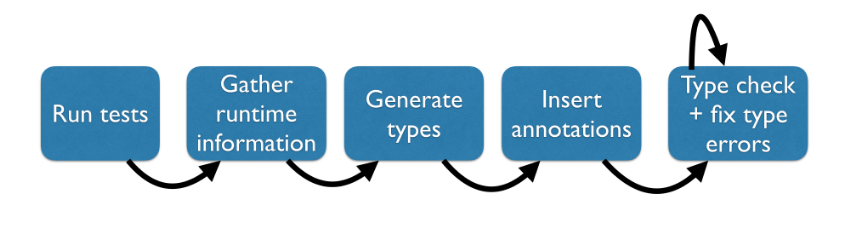
The ideal bottom-up pipeline
- Write the code (a prototype)
function mean(list) {
  return divide(sum(list), length(list))
}- Test it a bit by hand — collect a list of calls
[[1, 2, 3], 2], ...- Get tests from the run-time calls — extend or fix them if needed
describe(() => it(() => expect(mean([1, 2, 3])).toEqual(2)))The ideal bottom-up pipeline
- Generate type specs from them
const MeanSpec = Contract(Array(Number), Number)- Run generated tests against them — discover edge cases
jsc.assert(jsc.forall(
  [makeJsverifyArbitrary(MeanSpec.reflect.argsTypes)],
  list => mean(list)
))- Once the code is stable — switch to static mode and add the missing static types:
mean.js→mean.ts
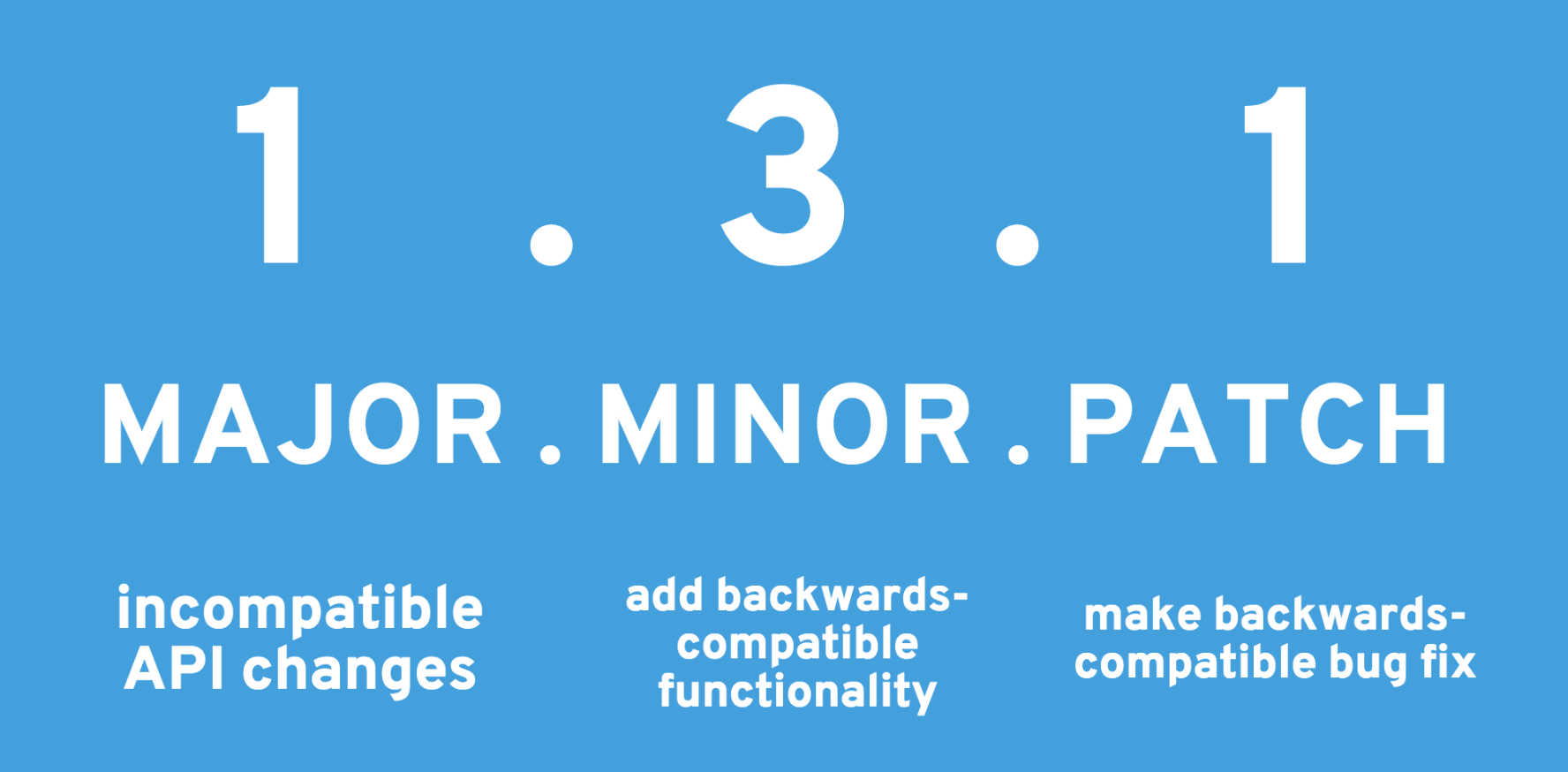
Automatically proving versioning is correct
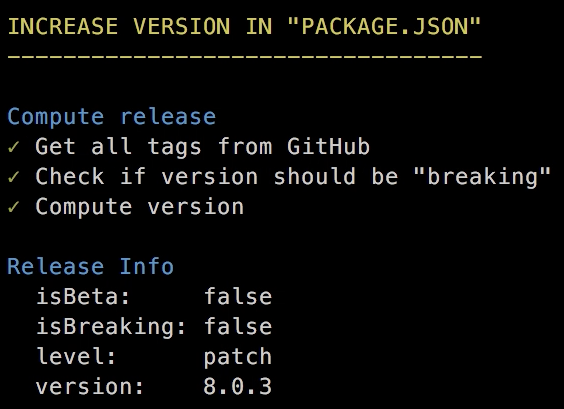
How do you prove a change is backwards compatible?
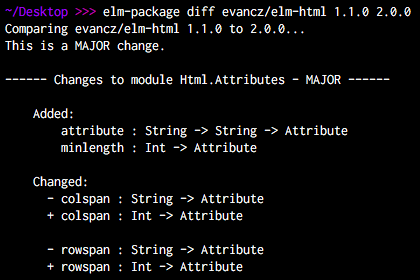
Problems?
mean.ts
We had tests:
it(() => expect(mean([1, 2, 3])).toBe(2))
it(() => expect(mean([])).toBe(0))
And types:
function mean(list: number[]): numberBut this change goes unnoticed:
 function mean(list) {
-  return meanFn(list)
+  return medianFn(list)
 }
Solution — combine the approaches
- We have a type description:
const MeanSpec = Contract(Array(Number), Number) - Check that the result hasn't changed for any input
import { mean as prevMean, MeanSpec as prevSpec } from 'project-prev/mean';
import { mean as currMean, MeanSpec as currSpec } from 'project-curr/mean';

// the specs themselves haven't changed (the "static" approach)
assert(isEqualSpec(prevSpec, currSpec))

jsc.assert(
  jsc.forall(
    [makeJsverifyArbitrary(prevSpec.reflect.argsTypes)],
    // and neither have the results (the "dynamic" approach)
    list => prevMean(list) === currMean(list)
  )
)- PROFIT!
Refinement types
Dynamic:
Number.withConstraint(v => v >= 0)How do you generate data of such a type?
Type Spec-driven development
User page · in list To Do: Frontend
Build the user page. API request GET /userInfo:
{ fio: { lastname: 'Ivanov', firstname: 'Ivan' }, balance: 1000000 }Displayed result: Name: Ivan Ivanov · Balance: 1 000 000 ₽
If the API returns invalid data, show a placeholder: An unexpected error occurred
Now let's try the top-down approach.
What do we want to get?
The overall spec:
type App = {
  {
    fio: {
      firstname?: string,
      lastname?: string
    } | !isEmpty v.lastname || !isEmpty v.firstname,
    balance: PositiveNumber
  }: {
    fio: FioString,
    amount: AmountString
  };
  any: HtmlError
}
Cases:
expect(app({
  fio: { lastname: 'Ivanov', firstname: 'Ivan' },
  balance: 1000000
})).toEqual({
  fio: 'Ivan Ivanov',
  amount: '1000000 ₽'
})
...
Find what you can't name
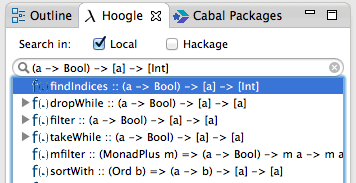
const solve = require('rambo').solve
const solution = solve([1, 2, 3, 4], [5, 6, 7, 8])
console.log(solution.name) // "R.map(R.add(4))"
Combining the approaches
- Somehow break the type mappings into the smallest pieces
{ firstname?: string, lastname?: string }
  | !isEmpty v.lastname || !isEmpty v.firstname
  -> FioString
PositiveNumber -> AmountString
...- Search the project and its libraries for matching specs
formatFio(
  { firstname?: string, lastname?: string }
): FioString
formatAmountRub(x: number): AmountStringA plan for laying off most programmers
A well-posed question is half the answer
- Dynamic proofs
- improve
runtypes-generate,io-ts-generate - generate data from predicates (refinement types)
- improve
- Static proofs
- refinement types in the mainstream (TypeScript)
- how refinement types, dependent types and Hoare logic relate
A plan for laying off most programmers
- Finish breaking the wall between dynamic and static properties
- Bottom-up
- tracing calls of entities (e.g. React components)
- generating tests from traces
- inferring types from traces
- Top-down
- searching specs across the project (a DB) or npm, validated by tests — a Hoogle for TypeScript
- AI
Appendix
Generator
function genPosNumber() {
  return Math.random() * 10000000000;
}
Property
function forall(argGenerators, propertyFn) {
  return function() {
    var generatedArgs = argGenerators.map(gen => gen());

    return {
      success: propertyFn(...generatedArgs),
      args: generatedArgs
    };
  }
}
Checker
function assert(property, tries = 100) {
  for (var i = 0; i < tries; i++) {
    var res = property();
    if (!res.success) {
      throw new Error(
        'Property hasnt held on arguments: '
        + JSON.stringify(res.args, null, 2)
      );
    }
  }
}
Into the test!
it('forall a, b - a + b >= a && a + b >= b', () => {
  assert(forall(
    [genPosNumber, genPosNumber],
    function (a, b) {
      return a + b >= a && a + b >= b;
    }
  ))
})
Hidden vs observable change
var a = { a: 1 };
changeObj(a) // hidden change

var a = { a: 1 };
var changedA = changeObj(a) // observable change
FRP:
var getCurrentUnixTimeWithDelay = () => Time.now() + 5
getCurrentUnixTimeWithDelay()
...
// hidden change
getCurrentUnixTimeWithDelay()

var time = Time.toBehavior()
var withDelay = time.map(now => now + 5)
// observable change
withDelay.sample(Time.interval(1)).subscribe(x => console.log(x))
Solutions?

- SMT (satisfiability modulo theories) solving
- Moving to dependent types — more general, but less convenient for programmers
Dynamic: Min(Number, 0)
Static: Min<Number, _0>
Managers' secret dreams xD